It’s the weekend and she joins the fringe of protesters in the triangle of sun inching its way around the mass of the City Chambers. The crowd is disjointed, not yet an ordered murmuration, flags still rolled up. While she waits for a friend she turns to face the square and tries once again to make sense of this space. Tiered like wedding cakes, the buildings that border it demand attention. They require the eyes to turn upwards, provoke a comparison of scale that can only find a citizen wanting.
Her friend arrives and together they find the student bloc. She takes a picture of them holding a placard that reads ‘“Decolonise the curriculum” starts now’. It’s time to march and the crowd comes together, filling the road like water finding a channel. Another friend texts to ask where they are in the procession and she says, ‘We are almost parallel with the Walter Scott monument’.
Its fluted column is like a giant sundial, casting a line to the north. She walks slowly past it, enjoying the opportunity to inscribe it with another meaning, to diminish some of its height and power. She notices how the moss has covered the stone lions whose faces adorn the roundels on the base, how the reach of empire can extend beyond the human.
She remembers the first iteration of this protest, how a group of teenagers used the lions’ noses as footholds and climbed up onto the base of the column draped in Palestinian flags like brightly coloured plumage as the crowd cheered them on and took photographs. She remembers the film in which the same chants provoke a tear gas attack, in which a man wraps his body around a beloved olive tree and is shot.
She’s not wearing a mask this time, though she probably ought to be. Like the statues of great men on their pedestals, the security cameras look down on the crowd from a height. The bird’s eye view must make more sense than the perspective from the ground. From the sky, the square becomes a great clearing in a stone forest. On the pavement it seems too large, too bare, and too open to be a place to relax in.
The gulls have taken up their position on the historic figures, icing the bronze heads with their white shit, occupying one of the few perches free of spikes. She thinks about how hard it is to spot discernible differences among more-than-human animals of the same species. There might be small differences that are obvious upon close inspection but these pale next to the huge range of combinations possible for a human face.
She walks past a poster for the campaign to remove the military grade CCTV cameras that are capable of recognising emotions as well as facial features. First developed for the purpose of surveilling and extorting Palestinians, they record sexual preferences, infidelities, financial problems or family illnesses—intelligence of dubious worth that is used to turn them into collaborators. She wonders if it’s the same camera as the ones posted on the gates of the arms factory, outside the university, if somewhere an algorithm is connecting the lineaments of her features with all these places she passes through as citizen, student, researcher, protester.
As they leave the pedestrianised area of the square the protestors fill city streets. It feels good to stop traffic, to jam the intersections of the grid system.
She remembers another iteration of this protest. A grey day where the mass of the City Chambers cast no shadow. The woman on stage pronounces it with a hard /z/ and it becomes gazza. She happened to be looking up at the cupolas that crown the corners of the building, and noticed the nets strung up in the arches to keep birds from sheltering in them and she hears it in her other mother tongue, where gazza is magpie.
The protesters’ chants are amplified and echoed by the chiselled cliffs of stone. No Justice, No Peace, in the conditional and the conjunctive. A call and response just like those of the songbirds in the park.
On the Monday after the protest she returns, walking the edges of the square, empty now. She maps time as well as space—the memory held in the stones looking down on the site goes back centuries, millennia, overwhelming the nine years of her own recollections. Still each scale creates an echo, a feedback loop that interrupts the present.
Temporary boards fixed to scaffolding poles describe the square as the city’s living room but the humans rarely outnumber the birds unless there is a protest, a football celebration or a festive market. The only benches, encircling the monument at the centre of the square, are mostly unoccupied.
The new headquarters of the refugee charity occupies the former offices of the Bank of Scotland. A video taken at sunset shows the view from the prayer room, the City Chambers bathed in Western light. Next door is the Merchants House, its domed tower topped with a ship sailing on the surface of a globe, its prow pointing west. The organisation’s crest bears a motto that hints unabashed at the logic of triangular trade, toties redeuntis eodiem, so often returning to the same place.
The buildings flaunt their grandeur and their permanence in the face of those confined to temporary contracts, rent hikes, and situations that make the danger of leaving outweigh that of staying. They are complicit in an unmarked history.
Months later, she passes on the bus. The square is enclosed by hoarding, the promised redevelopment is underway, the plinths temporarily shorn of their statues.
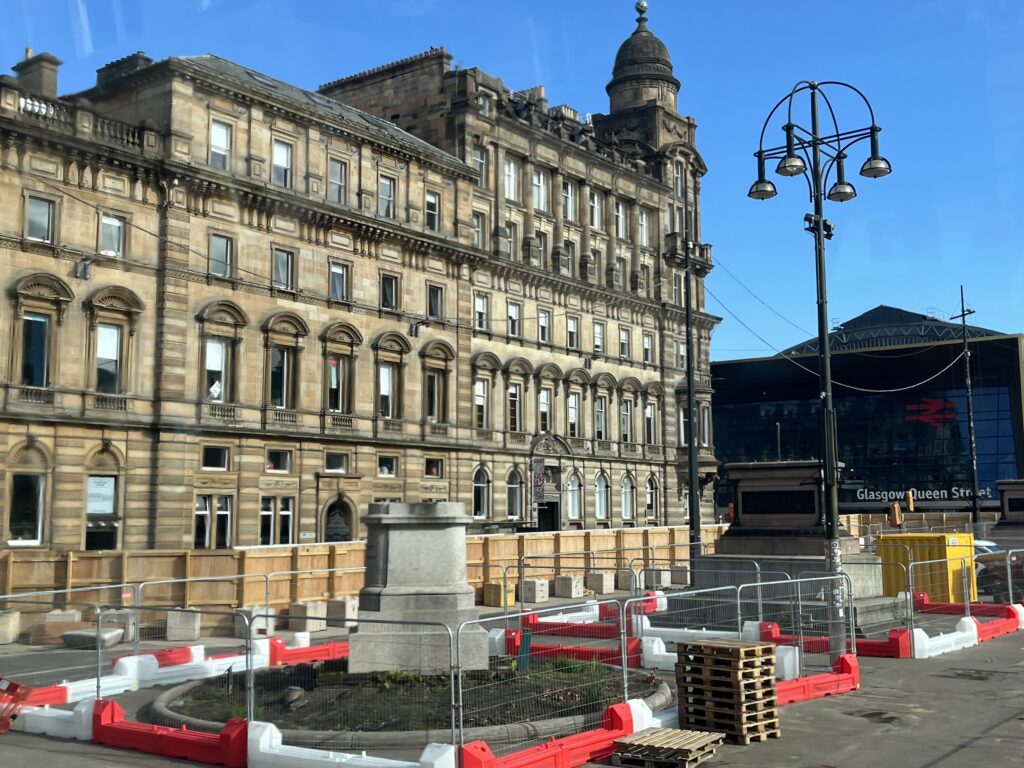
George Square, July 2025, photograph courtesy of Maria Howard